Hit-to-Kill (Non-Explosive)
Explosive-Based Interception
Defense Technology · Autonomous Interception
TEHIRU
AERIAL
SYSTEMS
AERIAL
SYSTEMS
Board Update & Strategy — Q1 2026
CONFIDENTIAL
CONFIDENTIAL — FOR AUTHORIZED RECIPIENTS ONLY — TEHIRU AERIAL SYSTEMS © 2026
Act I — What We’ve Done
02 / 20
YTD Highlights · 2025 – Q1 2026
Results at a Glance
Key operational and commercial milestones
>95%
C-UAS success rate
with Elbit partnership
with Elbit partnership
FIRST
Successful ATGM intercept
ever achieved by our system
ever achieved by our system
5
Full systems purchased
by the IDF
by the IDF
50
NS1.1 interception drones
delivered
delivered
Q3
US Army demonstration
scheduled 2026
scheduled 2026
2
Strategic defense partnerships
Elbit Systems · RADA (DRS)
Elbit Systems · RADA (DRS)
CONFIDENTIAL — FOR AUTHORIZED RECIPIENTS ONLY — TEHIRU AERIAL SYSTEMS © 2026
Act I — What We’ve Done
03 / 20
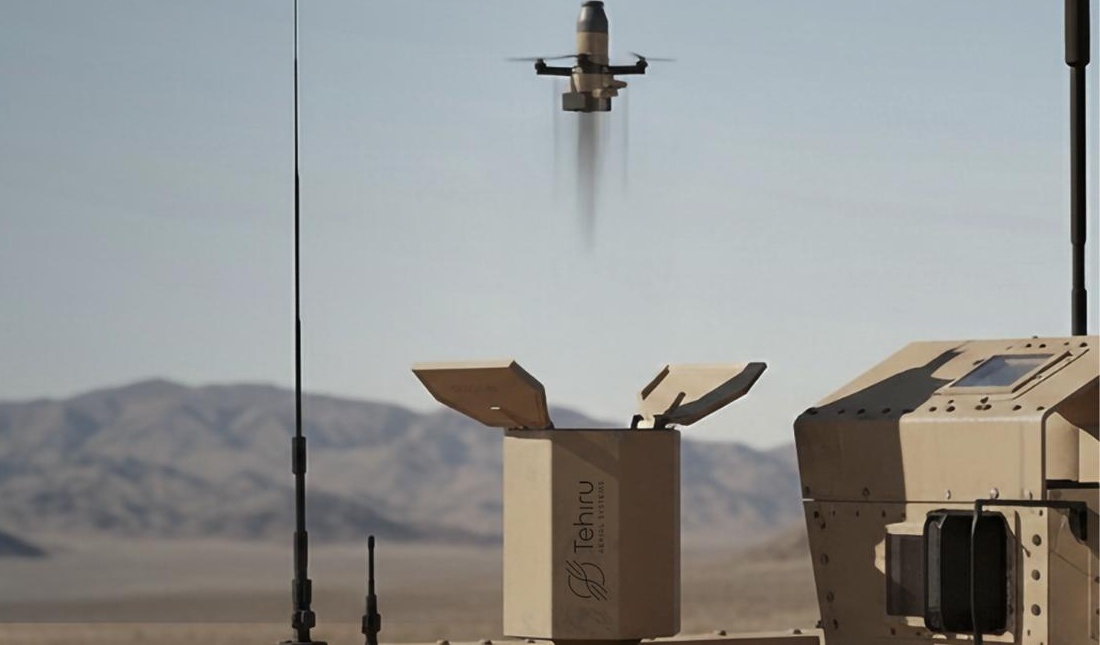
Strategic Partnership
Elbit Systems
Kinetic intercept · Explosive warhead system
>95%
C-UAS success rate
🏆
Historic Achievement
First successful ATGM interception ever by a drone interceptor worldwide
Program Milestones
- Successful demonstration program completed
- >95% C-UAS success rate validated in live demonstration
- First successful intercept of an ATGM
- IDF purchased 5 systems: 160 NS1.2 drones + 20 Hives
- US Army live demonstration scheduled for Q3 2026
Procurement Details
50
NS1.1 delivered ✓
160
NS1.2 in 2 months
20
Hives in 2 months
Next-Gen vs Legacy Systems
Replacing Trophy & Iron Fist
| Legacy | Nova Shield | |
|---|---|---|
| Threats | ATGMs only | UAVs, Drones & ATGMs |
| Recoil | Heavy — tanks only | Zero recoil |
| Platforms | Heavy armor only | Any land, air & sea vehicle |
Market Opportunity
20,000
JLTV vehicles
~$1B
revenue opportunity for Tehiru Aerial Systems
CONFIDENTIAL — FOR AUTHORIZED RECIPIENTS ONLY — TEHIRU AERIAL SYSTEMS © 2026
Act I — What We’ve Done
04 / 20
NS1 Interceptor — Hive Launch System
Preparing for installation on Israel’s northern border
CONFIDENTIAL — FOR AUTHORIZED RECIPIENTS ONLY — TEHIRU AERIAL SYSTEMS © 2026
Act I — What We’ve Done
05 / 20
Strategic Partnership
RADA Electronic Industries
Hit-to-kill intercept — no explosive, radar-guided homing
RADA
Hit-to-Kill · No Explosive
2km
Current range
→
10km
Expansion target
Q2 2026 Milestone
Successful hit-to-kill intercept by mid-Q2 2026
Program Status
- Goal: consistent successful hit-to-kill intercept
- Demonstrated ability to detect and navigate to target via radar alone
- Homing algorithm development advancing — final intercept phase in test
- Range: 2km current, expanding to 10km
- New interceptor design in development — modular, available to other partners
Why Hit-to-Kill Matters
No explosive payload = simpler logistics, broader export approvals, urban deployment. Radar-only homing that can integrate with thousands of radar systems already deployed worldwide.
CONFIDENTIAL — FOR AUTHORIZED RECIPIENTS ONLY — TEHIRU AERIAL SYSTEMS © 2026
Act I — What We’ve Done
06 / 20
Core Platform
Citadel — Tehiru Interception Architecture Stack
A layered open standard: any sensor, any platform, any kill method — same stack
Citadel Stack — click a layer to expand
L7
Kill Method
— neutralize the threat
▸
Explosive warhead
Kinetic hit-to-kill
Explosive Warhead
Deployed
Since Q3 2025
Kinetic Hit-to-Kill
In Dev
Target Q2 2026
L6
SharkOS
— fly, close, home
▸
Fly-To navigation
Close-In guidance
Sensor Homing
Fly-To Navigation
Deployed
Since Q1 2025
Close-In Guidance
Deployed
Since Q3 2025
Sensor Homing
In Dev
Target Q2 2026
L5
Interceptor Airframe
— the vehicle
▸
Nova Shield (Elbit)
Interceptor 1.0
Next-gen modular
Nova Shield (Elbit)
Deployed
Since Q2 2025
Interceptor 1.0
In Dev
Target Q3 2026
Next-gen Modular
Planned
2027+
L4
Deployment Platforms
— launch the asset
▸
Hive launcher
Heavy Lifter
Mobile vehicle
Hive Launcher
Deployed
Since Q3 2025
Heavy Lifter
Planned
2027+
Mobile Vehicle
Planned
2027+
L3
Battle Management
— decide the response
▸
1:1 allocation
Many-to-many
Swarm coordination
1:1 Allocation
Deployed
Since Q1 2025
Many-to-Many
In Dev
Target Q4 2026
Swarm Coordination
Planned
2027+
L2
Integration API
— feed the data
▸
Single sensor input
Std. protocols
Multi-sensor API
Single Sensor Input
Deployed
Since Q1 2025
Std. Protocols
Deployed
Since Q3 2025
Multi-sensor API
Planned
2027+
L1
Sensors & Detection
— see the threat
▸
RADA Radar
Ground optical cams
Multi-sensor fusion
RADA Radar
Deployed
Since Q2 2025
Ground Optical Cams
Deployed
Since Q3 2025
Multi-sensor Fusion
Planned
2027+
Operational
In Dev
Planned
Citadel Configurations
ELBIT
Project Elbit — Nova Shield
L1 RADA Radar + Ground optical cameras
L2 Single sensor fusion
L3 Single target allocation
L4 Hive
L5 Nova Shield drone
L6 SharkOS: Fly-To + Close-In
L7 💥 Explosive warhead
RADA
Project RADA — Interceptor 1.0
L1 🟢 RADA Radar
L2 🟢 Single radar input
L3 🟢 Single target allocation
L4 🟢 Hive
L5 🟡 Interceptor 1.0 airframe
L6 SharkOS: 🟢 Fly-To + Close-In + 🟡 Sensor Homing
L7 🎯 Kinetic hit-to-kill
🔮 Future Config Example
L1 Multi-sensor 🔵 → L2 Fusion API 🔵 → L3 Swarm (many:many) 🔵 → L4 Heavy Lifter 🔵 → L5 Next-gen airframe → L6 Full autonomy → L7 Mission-configured
CONFIDENTIAL — FOR AUTHORIZED RECIPIENTS ONLY — TEHIRU AERIAL SYSTEMS © 2026
Act I — What We’ve Done
07 / 20
Internal Technology
Proprietary Subsystems
The internal building blocks powering our interception platforms
CORE
TehiruFC
Proprietary Flight Controller
Purpose-built autonomous guidance system for interception missions. Handles navigation, target tracking, and terminal homing across all interceptor variants.
COMMS
StratoLink Suite
SwiftLink
EW-resilient telemetry & command link. Operates in contested electromagnetic environments where GPS and standard comms fail.
HappyLink
Secure video downlink for real-time ISR feed. Low-latency, encrypted, jamming-resistant.
WEAPONS
SparkLink
Modular safe & secured weapon activation system. Works across ground and airborne platforms. Enables ad-hoc weapon integration without custom engineering per platform.
All subsystems are Tehiru-proprietary IP — designed for cross-platform modularity
CONFIDENTIAL — FOR AUTHORIZED RECIPIENTS ONLY — TEHIRU AERIAL SYSTEMS © 2026
Act II — Why It Matters
08 / 20
The Market Crisis
The World Is Running Out of Interceptors
Cost asymmetry + autonomous gap = existential defense problem
“In March 2026, Israel ran critically low on interceptors”
Source: Semafor, March 2026 · Operation Roaring Lion, Israel-Iran conflict
$20K
Cost per
attack drone
attack drone
vs
$100K+
Cost per
interceptor
interceptor
5:1 Cost Asymmetry
Every exchange favors the attacker. Mass drone warfare makes traditional interception economically unsustainable at scale.
The Critical Gap
Currently available UAV, drone and ATGM interception systems are NOT autonomous.
Human-in-the-loop delays, high cost-per-intercept, slow production timelines, and finite magazines — while drone supply is effectively infinite.
CONFIDENTIAL — FOR AUTHORIZED RECIPIENTS ONLY — TEHIRU AERIAL SYSTEMS © 2026
Act II — Why It Matters
09 / 20
Context · Israeli Tech Ecosystem
Israeli Tech Under Fire
Innovation Authority survey, 3rd week of conflict, March 2026 — 637 companies
The Israeli Tech Reality
87%
Product dev delays
71%
Fundraising hit
48%
>25% staff absent
35%
Global biz impact
31%
Considering relocation
20%
Supply chain delays
Source: Israel Innovation Authority, March 2026 (637 companies surveyed)
Meanwhile, Tehiru…
✅ Deploying NS1.2 to northern border
✅ 2 strategic defense partnerships
Elbit Systems + RADA Electronic Industries
✅ Revenue: $140K/month average
✅ Team rebuilt & growing
19 → 24 by mid-2026
✅ Entering US market
CTO on the ground
✅ Closing $10M SAFE round
In the hardest environment for Israeli tech in a decade, Tehiru is growing — because we’re solving the crisis, not surviving it.
CONFIDENTIAL — FOR AUTHORIZED RECIPIENTS ONLY — TEHIRU AERIAL SYSTEMS © 2026
Act II — Why It Matters
10 / 20
Total Addressable Market
$71B Growing to $130B by 2032
Global interception & air defense — all tiers combined
TAM TODAY (2025)
$71B
4-tier combined market
Precedence Research · MarketsandMarkets · Allied Market Research · Euroconsult/SIA
PROJECTED (2032)
$130B
~9% blended CAGR
TEHIRU ENTRY TIER
$17B
C-UAV/SHORAD — 12% CAGR
MarketsandMarkets + Precedence Research
CONFIDENTIAL — FOR AUTHORIZED RECIPIENTS ONLY — TEHIRU AERIAL SYSTEMS © 2026
Act II — Why It Matters
11 / 20
Market Structure
Four Tiers of Interception
From counter-drone to satellite — the full kill chain market
Tier 1 · 0–15 km · TEHIRU CURRENT
Short Range — C-UAV / SHORAD / DEW
$17B (2025) → $39B (2032)
12% CAGR
Drones, UAVs, ATGMs, rockets, mortars. Fastest growing tier driven by mass drone warfare. DEW submarket: $5.3B → $12.9B at 19.6% CAGR.
MarketsandMarkets Counter-UAV Report · Precedence Research Air Defense 2024 · DEW: MarketsandMarkets
Tier 2 · 15–100 km
Medium Range — MRAD / Theater Defense
$17B (2025) → $28B (2032)
7% CAGR
Cruise missiles, tactical ballistic missiles, large UAVs. MRAD captured largest revenue share in air defense in 2024. NATO rearmament wave driving demand.
Precedence Research Air Defense System Market 2025 (MRAD ~$16–18B est.)
Tier 3 · 100–2,000+ km
Long Range — Ballistic Missile Defense (BMD)
$22B (2025) → $38B (2032)
7.8% CAGR
MRBMs, IRBMs, ICBMs. Arrow 2/3, THAAD, Aegis BMD. Israel Arrow program annual budget ~$1B+. Iran/North Korea MRBM proliferation driving demand.
Allied Market Research Ballistic Missile Defense Market 2023
Tier 4 · Exo-atmospheric
Space / Anti-Satellite (ASAT)
$15B (2025) → $25B (2032)
7.5% CAGR
Satellites (recon, comms, nav). Space is now a warfighting domain (US Space Force, est. 2019). ASAT market <$2B today, growing rapidly. SSA: $1.5B → $3.5B by 2030.
Euroconsult Space Economy Reports · SIA (Space Investment Association)
CONFIDENTIAL — FOR AUTHORIZED RECIPIENTS ONLY — TEHIRU AERIAL SYSTEMS © 2026
Act II — Why It Matters
12 / 20
The Opportunity
Why Existing Solutions Fail
Four critical failures — one autonomous answer
Not Autonomous
Human-in-the-loop decision delays create fatal reaction time gaps. Modern drone swarms execute faster than any human operator can respond.
Too Expensive
$40K–$100K+ per intercept vs $20K attack drones. Cost asymmetry makes kinetic defense economically unsustainable at scale against mass swarms.
Too Slow to Produce
Traditional interceptors take months to manufacture. Israel ran critically low on interceptors despite its advanced defense industrial base. (Semafor, March 2026)
Finite Magazine
Every conventional system has a magazine limit. Adversaries using effectively infinite drone supply can exhaust defenses before reloading is possible.
⚡
AI-First Autonomous
SharkOS makes autonomous intercept decisions in milliseconds. No human latency in the kill chain.
💰
Low-Cost Interceptor
3D-printable components & photocurable propellants compress cost-per-intercept dramatically.
🏭
Rapid Manufacturing
Rocket motors in minutes not days. Scale to demand. Hive architecture = distributed, renewable magazine.
CONFIDENTIAL — FOR AUTHORIZED RECIPIENTS ONLY — TEHIRU AERIAL SYSTEMS © 2026
Act II — Why It Matters
13 / 20
Competitive Position
Where Tehiru Sits
Short range C-UAV — the hottest tier — expanding to medium range
Current Position
Short Range C-UAV / SHORAD
12% CAGR
$17B (2025) → $39B (2032) — fastest-growing tier (MarketsandMarkets + Precedence)
Expansion Target
Medium Range → 90km
New interceptor + solid rocket booster program in development
Competitive Moat
- AI-first: autonomous decision engine — not bolted on, built in from day one
- EW-resilient: StratoLink works where competitors’ comms fail
- Software-defined: hardware-agnostic = faster iteration than defense primes
- Full kill chain: Identify → Neutralize already operational today
System
Autonomous
Low Cost
C-UAV
Tehiru / SharkOS
✓ Yes
✓ Yes
✓ Yes
Iron Dome (Rafael)
✗ No
✗ $40–100K
✗ Limited
C-RAM / Phalanx
✗ Semi
✗ High
✗ Limited
DroneShield (EW)
✗ Semi
~ Moderate
✓ Yes
Iron Beam (DEW)
✗ No
✓ ~$3.50/shot
✓ Yes
Generic C-UAS systems
✗ No
✗ High
✓ Yes
Source: Jane’s Defence · public procurement data · company filings
CONFIDENTIAL — FOR AUTHORIZED RECIPIENTS ONLY — TEHIRU AERIAL SYSTEMS © 2026
Act III — Where We’re Going
14 / 20
2026 Strategy
US Market Entry
Establishing Tehiru USA — accessing the world’s largest defense market
Tehiru USA — Subsidiary Formation
1
Establish US subsidiary (Tehiru USA) — NDAA-compliant corporate structure
2
Key hires: General Manager (USA), Chief Engineer, Lead Pilot
3
Recruit Board of Advisors with DoD and defense industry access
4
US ownership of all demos, field integrations, and deployments
Manufacturing & Integration Partners
1
Identify US manufacturing partner for interceptor & Hive assembly
2
Identify system integration partners for DoD prime contract access
3
Evaluate US/NATO detection & sensor companies (on-board radar + EO homing)
4
Build & test prototype drones with US sensor integration; conduct intercept tests
CONFIDENTIAL — FOR AUTHORIZED RECIPIENTS ONLY — TEHIRU AERIAL SYSTEMS © 2026
Act III — Where We’re Going
15 / 20
R&D Roadmap 2026–2027
Technology Roadmap
Two pillars — from 2km interception today to 90km by 2027
Capability Progression: Current → Target (2027)
Detection
<14km
Current
Interception
→ 90km
Altitude
<3km
→ >6km
01
Energetic Photocurable Polymers
Hybrid fuel grain + composite solid rocket motors
Rocket motors in minutes (vs days/weeks traditional)
3D printable multifunctional structural explosives
Locally sourced low-cost propellants (Israel-based manufacturing)
Iron Dome / Arrow booster replacement path
02
SWaP-Optimized Air-to-Air Sensors
Low-cost EO sensor for terminal homing guidance
Low-cost radar sensor for mid-course navigation
Mid-range (10–90km) interceptor platform development
Short-range (<10km) upgraded interceptor
Multi-sensor fusion for GPS-denied environments
CONFIDENTIAL — FOR AUTHORIZED RECIPIENTS ONLY — TEHIRU AERIAL SYSTEMS © 2026
Act III — Where We’re Going
16 / 20
Growth Strategy
Four Phases to Full Kill Chain
Drones to satellites — cumulative TAM grows from $17B to $130B by 2032
P1
Short Range C-UAV (2025–2026)
Drone/ATGM interception, IDF + NATO entry, US subsidiary establishment
TAM: $17B (MarketsandMarkets + Precedence Research)
P2
Medium Range 90km (2027–2028)
Cruise missiles, tactical ballistic missiles, large UAVs (15–100km)
Cumulative TAM: $34B (Precedence Research Air Defense 2025)
P3
Long Range / BMD (2029)
MRBMs, IRBMs, exo-atmospheric interception up to 2,000+km
Cumulative TAM: $56B (Allied Market Research BMD 2023)
P4
Space / ASAT (2030)
Satellite interception, active debris removal, orbital defense
Total TAM: $71B → $130B by 2032 (Euroconsult/SIA)
Vertical integration path: Sensor partner evaluation → prototype testing → end-to-end system ownership across all four tiers
CONFIDENTIAL — FOR AUTHORIZED RECIPIENTS ONLY — TEHIRU AERIAL SYSTEMS © 2026
Act III — Where We’re Going
17 / 20
Organization
Team & Growth
From generalist startup to specialized defense company
March 2025
21
Generalist roles
March 2026
22
19 FT + 3 outsource · Specialized
Post-SAFE Target
29–31
30% growth · Key hires
Current Organization — Under Aaron Prat, CEO
Operations
Moti · 5 people
R&D
Haim · 4 (+1 Apr)
Engineering
Hiring Mgr · 2+1
BizDev
Nir · 1 (Liraz)
US Market
Jacob (CTO)
Finance
Ifat · 1 outsource
HR
Nitsan · 1 outsource
Board of Directors
Aaron Prat
Niro Ben-Zvi
Jules Trump
Shimon Alevy
Steven Alevy
Post-Investment Additions
Shahar Abuhazira Chairman, US defense expert
Yaakov Amidror Fmr. Maj. Gen. & NSA of Israel
[New Investor Seat]
CONFIDENTIAL — FOR AUTHORIZED RECIPIENTS ONLY — TEHIRU AERIAL SYSTEMS © 2026
Act III — Where We’re Going
18 / 20
Financials
Financial Overview
Strong unit economics with conservative runway projections
$140K
Revenue/month
(average)
(average)
$225K
Burn rate/month
~$110K
Net burn/month
(conservative, +30% buffer)
(conservative, +30% buffer)
$2.8M
Cash on hand
~25mo
Runway
(conservative estimate)
(conservative estimate)
Revenue Growth
$500K
2025
$660K
Q1 2026
alone
alone
$1.6M
2026 proj.
US Entry Investment — $2.42M / 16 months
$65K
/mo · M1–4
→
$120K
/mo · M5–10
→
$240K
/mo · M11–16
CONFIDENTIAL — FOR AUTHORIZED RECIPIENTS ONLY — TEHIRU AERIAL SYSTEMS © 2026
Act III — Where We’re Going
19 / 20
Fundraise
SAFE Round — $10M
Pre-money valuation: $45M — Speed to close, speed to deploy
Raising
$10M
SAFE · $45M Pre-Money
Round Type
SAFE
Pre-Money
$45M
“Pivoted from SPA to SAFE — faster process lets us focus on deploying interceptors in the north and entering the US market.”
Use of Funds
🇺🇸 US Market Entry — $2.42M / 16mo
Establish Tehiru USA, manufacturing, regulatory, local team
📈 Team Growth — 30% headcount
Specialized engineering hires across all departments
🚀 Accelerate Deployment
Productionize system, expand to more locations, maximize deployed units
🔬 Accelerate R&D
2–10km range expansion, swarm interception, medium-range (solid rocket booster Q4)
Post-Investment Board
Aaron
Niro
Jules Trump
Shimon Alevy
Steven Alevy
+ Shahar Abuhazira (Chairman)
+ Yaakov Amidror (Fmr. NSA)
+ [Investor Seat]
CONFIDENTIAL — FOR AUTHORIZED RECIPIENTS ONLY — TEHIRU AERIAL SYSTEMS © 2026
Act III — Where We’re Going
20 / 20
The Vision
From counter-UAV to
satellite interception —
full kill chain by 2030.
satellite interception —
full kill chain by 2030.
No other company offers this trajectory. Tehiru starts where the market is hottest — counter-UAV at 12% CAGR — with SharkOS already delivering autonomous detect-to-neutralize. The same autonomous decision engine scales from drone interception to orbital satellite engagement. By 2030, Tehiru owns the full interception kill chain. TAM grows from $17B at entry to $130B by 2032.
tehiru-aerial.com
Q1 2026 · Confidential Board Update
Market Data Sources
Precedence Research: Air Defense System Market 2024/2025
MarketsandMarkets: Counter-UAV Market Report 2023
MarketsandMarkets: Directed Energy Weapons Market
Allied Market Research: Ballistic Missile Defense Market 2023
Euroconsult: Space Economy Reports
SIA (Space Investment Association)
SIPRI: Global Military Expenditure Database 2024
Semafor: “Israel running critically low on interceptors” (March 2026)
Jane’s Defence: Systems specifications & procurement data
CSIS Missile Defense Project: missiledefense.csis.org
CONFIDENTIAL — FOR AUTHORIZED RECIPIENTS ONLY — TEHIRU AERIAL SYSTEMS © 2026
Comments